Event 1
Azgod'Kalar's Falling Experiment

[Azgod'Kalar's Falling Experiment](entity:event-recall-event-0ae378144652) is a decisive turning point in Maggie’s partial education as a human being. Seeking to understand fear rather than merely describe its chemistry, Maggie selects [Azgod'Kalar the Calm](entity:character-recall-character-azgod-kalar-the-cal-22dc0698e97d) as a test subject, places the snake in mortal danger, and discovers through her own bodily panic that the creature matters to her. The event transforms an apparently insignificant pet into evidence of emotional attachment, while its aftermath makes Maggie acknowledge that intelligence without restraint can become cruelty.
## Causes and Experimental Design
Maggie’s plan begins with a problem in self-knowledge. She understands fear as a set of chemical reactions and physiological effects, and she knows what kinds of stimuli can provoke or suppress those reactions, but she has never personally experienced the emotion. As [Magh'rathlak the Observer](entity:character-recall-character-magh-rathlak-the-ob-569fc2868ffe), she had survived conflicts with the [Elder Ones](entity:creature-recall-creature-elder-ones-5efb3be64169) because her immortal consciousness could reconstitute itself after apparent destruction. Her immense age, observational habits, and preference for study and experimentation had left her emotionally stunted; concepts such as fear, joy, love, sorrow, and anger had once been outside her lived experience.
Her transformation into Maggie has begun to alter that condition. A partially human existence has given her access to feelings that cannot be mastered through detached analysis alone, yet fear remains resistant to her usual methods. Extinction and bodily mutilation cannot frighten her because losing a physical shell has little consequence. The unknown attracts rather than repels her, and submission to an Elder One’s will seems more infuriating than terrifying. She considers fear of losing another person a more promising possibility, remembering that the earlier soap-opera incident may have involved such a response, although anger and violated obligations had contaminated that experience. [Joe Mulligan](entity:character-recall-character-joe-mulligan-97d1f45a6068) is too important and too dangerous a subject to use, so Maggie searches for another living being to place at risk.
The shoggoth-infested Full Immersion Pod is rejected because Maggie’s pet project has no sentimental value to her. Destruction of the shoggoth would waste time and effort, but would not produce the emotional investment required for genuine fear of loss. Her attention then settles on the small snake resting around her right hand. Azgod'Kalar is practically useless to her and was acquired through what the narration describes as an arbitrary whim, yet that very creature becomes the experiment’s chosen subject. The selection reveals Maggie’s mistaken premise: she treats emotional significance as something that can be created by a controlled test, without first recognizing that affection may already be present.
## The Fall from the Hyper-Scraper
Maggie leaves Joe Mulligan’s apartment and takes the nearest elevator to floor 190 of the hyper-scraper. She opens a person-sized passage through a large shatterproof window by bending its molecules, steps into the freezing high-altitude wind with Azgod'Kalar hidden inside her sleeve, and closes the opening behind her. She then walks vertically up the building’s exterior, treating gravity as negotiable, until she reaches the rooftop roughly thirty meters higher.
The rooftop is crowded with satellite dishes, signal towers, lightning rods, backup generators, and other maintenance machinery. Maggie surveys the conditions with the exactness of a laboratory technician. The gap to the opposite hyper-scraper is about fifteen meters; the buildings sway in the wind, making measurement difficult. She estimates her position at 816 meters above sea level and calculates approximately 270 meters of clearance above the uppermost high road. Even the extreme wind speeds are judged unlikely to interfere with the experiment.
Once satisfied, Maggie retrieves Azgod'Kalar and lightly pinches the snake’s midsection between two fingers. She extends her arm over the ledge. The confused serpent coils around her fingers in an attempt to avoid the danger, but Maggie classifies the fall as necessary for research. Azgod'Kalar the Calm weighs only thirty grams. When Maggie releases it, the wind immediately catches its small body while gravity pulls it downward. She can follow its descent with perfect accuracy and calculates that it will strike the ground in seven seconds. Her reasoning remains coldly utilitarian: the snake’s life is brief, hers is immeasurably long, and the animal’s death can therefore be assigned greater purpose as an experiment than its continued existence.
The test subject’s status as an engineered companion intensifies the ethical contradiction. Azgod'Kalar is an orb python, a smaller and more docile genetic offshoot bred for the space-faring human population; its subspecies has had most of its natural ferocity surgically removed. The same wider program modified more than a hundred species to discourage humans from adopting dangerous extraterrestrial animals merely because they looked appealing. Maggie’s relationship with Azgod'Kalar nonetheless exceeds simple ownership. She carries it in her sleeve during travel, teaches it to imitate gestures, and later grants it perpetual youth. These details make the fall an assault on a companion whose value is repeatedly demonstrated even when Maggie temporarily denies it.
## Fear Becomes Physical
Maggie watches the descent without apparent conflict. She does not take pleasure in tormenting Azgod'Kalar and does not understand herself as cruel; in her calculation, the snake’s death is an acceptable cost of personal development. The animal becomes dormant in the cold and may die before reaching the pavement. Maggie expects to observe the result from above, protected by her certainty that the experiment concerns an emotion she does not possess.
The experiment reverses that certainty in an instant. A boom shakes the hyper-scraper as Maggie exceeds the speed of sound. She reaches the high road with an impossibly soft landing, but the controlled human facade has broken. Her eyes widen, her mouth hangs open, and she hyperventilates while her heart pounds and a bead of cold sweat runs down her forehead. These bodily reactions precede any successful conceptual explanation: fear arrives first as breath, pulse, shock, and movement.
Within her cupped hands lies Azgod'Kalar, still alive. Maggie has crossed the distance and rescued the snake before its calculated death, although the narrative does not present the act as a calm revision of the experiment. Her body has answered a threat to the animal before her abstract mind can defend the original premise. The result is therefore more revealing than a simple survival: Maggie learns that she is capable of fearing the loss of another being, and that the emotional bond she claimed was absent had already become strong enough to overcome her indifference.
## Confrontation and Remorse
The experiment’s immediate consequences include police intervention. An officer reports that Maggie threw her pet from the top of the hyper-scraper, and Joe Mulligan confronts her over the act. The police cannot identify her through fingerprints or DNA, but military authority orders her release and commands the force to erase its records. The order actually comes from the [Supernatural Eviction Agency](entity:organization-recall-organization-1fbafc4808b3), which wants to prevent local officers from provoking the unusually cooperative Class-3 cosmic entity. Institutional power therefore removes the legal consequences before Maggie has fully faced the personal ones.
Joe’s objection supplies the moral pressure the authorities do not. When he asks why she would do such a thing, Maggie cannot initially understand the problem. Her confusion is genuine: she has categorized the snake as an expendable experimental subject and sees no self-evident reason that a useful test should be forbidden. Joe points out that she should have told him before carrying out an idea that placed a life in danger. He also reminds her that her tendency to push experiments too far is precisely why she bonded herself to him as a guide and stabilizing influence.
Maggie recognizes that she has violated obligations both to Azgod'Kalar and to herself. She had sought emotional growth but repeated the detached habits that had previously made her interactions with the material world unproductive. Her apology is quiet and marked by intense remorse, a striking contrast with the stone-faced observer who watched the snake fall. Joe accepts it only on the condition that she never repeat the experiment, while clarifying that he is not demanding permission for every action—only consultation when an idea could endanger a life. Maggie had already reached the same conclusion: once was enough to experience fear.
## Consequences and Significance
The falling experiment changes the meaning of Azgod'Kalar in Maggie’s life. Before the fall, she describes the snake as an insignificant creature of negligible practical use. Afterward, the animal travels tucked into her sleeve, learns to imitate her thumbs-up gesture, and remains part of her continuing life. Joe’s later discovery that Azgod'Kalar has remained a hatchling because Maggie granted it perpetual youth confirms that the relationship has produced a durable form of care, even if Maggie’s methods remain extraordinary.
The event also establishes that Maggie’s humanity cannot be measured by her ability to explain human emotions. She already possesses the relevant biological knowledge, but knowledge does not become understanding until the threatened loss of Azgod'Kalar forces a reaction beyond calculation. Her fear is not fear of her own death, nor reverence before the unknown, but the sudden recognition that another life has become emotionally non-interchangeable. The experiment intended to manufacture an emotion instead uncovers an attachment.
Its moral structure remains deliberately uncomfortable. Maggie saves Azgod'Kalar, but only after creating the danger and calculating its death to the second. Her rescue does not erase the cruelty of the test; it proves that her capacity for attachment coexists with a dangerous willingness to instrumentalize living beings. Joe’s rebuke and Maggie’s remorse turn the incident from a successful demonstration into a lesson in responsibility. The decisive value shift is from detached control to involuntary care, followed by the recognition that emotional development cannot be ethically separated from obligations toward the beings used to achieve it.
The event therefore functions as both a fear experiment and a failed experiment in objectivity. Maggie begins by treating herself as a neutral observer and Azgod'Kalar as data. She ends with a living companion in her hands, a body shaken by panic, and a new prohibition against repeating the test. The fall does not make her ordinary, but it gives her a concrete, bodily reason to limit the methods by which she seeks to become more human.
Event 2
马洛尼对玛姬的调查

[Grant Maloney](entity:character-recall-character-grant-maloney-5197c080f73d)’s investigation into Maggie is the story’s clearest movement from ordinary law enforcement into cosmic mystery. What begins with erased criminal records and suspicious transactions becomes a self-directed inquiry into a woman whose human appearance conceals a Class-3 cosmic entity. Maloney’s importance lies not in authority—his superiors repeatedly prove able to override his work—but in his refusal to let an unexplained case disappear. His investigation turns curiosity into a force capable of crossing institutional, technological, and ontological boundaries.
## The Case Behind the Investigation
Maloney first encounters the matter as an administrative anomaly rather than a grand supernatural mystery. After bringing [Joe Mulligan](entity:character-recall-character-joe-mulligan-97d1f45a6068) into the station, he learns that military personnel he never sees have pressured his captain to erase the official records. In the heavily automated society of the [3rd British Empire](entity:organization-recall-organization-3rd-british-empi-bb46cf0c765c), deleting those records makes the incident effectively nonexistent. Maloney nevertheless keeps private notes, because the disappearance of the case conflicts with his sense that something is wrong and because it is the first genuine puzzle he has encountered during six years on the force.
His attention soon shifts from Maggie to Joe Mulligan. Joe is twenty-two, born and raised in [Dave-156](entity:location-recall-location-dave-156-f9da3142838d), unemployed, and apparently unremarkable, with both parents alive and no obvious distinction from the other residents of the mega-city. His transaction history, however, reveals that he donated money to Dave Willabang several weeks earlier. Willabang had received similar contributions from dozens of people and used the combined funds to purchase a disused factory complex, yet nearly every contributor was later reported detained or killed for conspiring against the state. Joe alone had apparently survived the incident, a coincidence that made Maloney suspect he was involved in something far beyond his apparent capacity.
The financial evidence becomes stranger still. Joe’s account had processed thousands of tiny transfers involving an enormous number of people. Each payment was immediately refunded at the sender’s request, and the amounts were so small that [Butterpond-4](entity:location-recall-location-butterpond-4-7d9f8fbb3f4f)’s banking software treated them as effectively zero. Nevertheless, Joe’s balance increased by two hundred poundingtons. Maloney’s technical training allows him to identify the mechanism: a distributed rounding error had made money appear without directly altering any account balance or triggering an automated audit. The discovery suggests that someone had found and exploited an exceptionally subtle weakness in the banking system, transforming apparently meaningless transactions into a source of funds.
## From Official Duty to Personal Curiosity
Maloney understands that continuing the inquiry is dangerous. The military’s intervention implies government involvement, and a low-ranking officer has little power to challenge either the state or whatever force stands behind Maggie and Joe. He also recognizes that his evidence does not fit Joe’s appearance. Joe’s thin, inactive physique and casual, uncertain manner make him look like an ordinary civilian rather than a criminal mastermind, government agent, or trained infiltrator. That contradiction intensifies rather than resolves the mystery.
The decisive motive is not duty, money, justice, or public safety alone. Maloney experiences the investigation as the first subject in his life to command his full attention. The thrill of uncovering the hidden structure behind the case becomes intoxicating, and he begins an unofficial inquiry that is not technically illegal but is plainly beyond the safe limits of his position. Since Joe and Maggie spend most of their time inside their apartment and Maloney cannot enter unnoticed, he begins asking questions in the neighborhood instead.
This street-level search produces the first useful public trace. Within an hour, Maloney hears rumors about a “[Pale Goddess](entity:expression-recall-expression-pale-goddess-a5e5fb0db649)” circulating on local message boards. The trail leads him to [Lyfe Haxx](entity:location-recall-location-lyfe-haxx-6169f0a4d9c2), a variety store, and demonstrates how Maggie’s identity has already begun to exist in two forms: as an apparently unusual girl encountered in public and as a myth assembled by observers who cannot explain what they have seen. Maloney treats those rumors neither as proof nor as mere gossip. He uses them as provisional clues in a larger chain.
## Following Maggie Across Realities
The investigation becomes more difficult because Maggie’s appearance changes with context. In her human manifestation, she resembles a beautiful girl, but living details betray the entity beneath the flesh: her raven-black hair moves as if alive, her eyes resemble gateways into an unspeakable void, and her pale skin feels subtly unnatural. In [V-Life](entity:location-recall-location-v-life-f6d3b624dedd), her avatar is visibly incomplete, with a human face, arms, and torso attached to a lower body of dark, eye-filled tendrils. Joe accepts the distortion partly because he spends so much time in virtual reality, where nonhuman forms are common, but to Maloney the discrepancy becomes another sign that Maggie’s identity cannot be reduced to an ordinary body.
Maloney follows the case into the virtual arena during the Blastopia competition. He watches Maggie and Joe participate as Triple Misfire, observing Maggie’s half-human, half-horror form while she operates the controls. He remains in the spectator area and becomes convinced that she looks toward him through the giant screen. By the time the team reaches its fourth match, followed by a sudden forfeit, he has gathered enough behavioral evidence to pursue a further clue: the strange signature associated with the case.
The signature is not decoded through official police resources. Instead, Maloney searches the online world for information about a subject he had previously dismissed as fabricated nonsense. During the flight to Joe’s hyper-scraper, he discovers what the mark means. The realization is both alarming and humiliatingly easy once he knows where to look, revealing that the barrier was not the absence of evidence but his failure to recognize the relevant interpretive frame.
## The Recognition of [Magh'rathlak the Observer](entity:character-recall-character-magh-rathlak-the-ob-569fc2868ffe)
At Joe’s apartment, Maloney finds Maggie waiting outside with a smug smile and a tiny serpent on her shoulder. He addresses her as Magh'rathlak the Observer, converting a rumor, a signature, and a series of contradictions into an explicit identification. Maggie confirms that he has arrived, but Maloney admits that he does not understand why he came and recognizes that the visit was reckless.
Maggie’s explanation changes the meaning of the investigation. She tells him that he is there because he felt the call: the same need to understand, desire to learn, and yearning for knowledge that continually drives her. Maloney’s curiosity, starved by the routine of his existence, has been awakened by the enigma of her being and has carried him through both internal and external discovery to this particular meeting. The investigation therefore does not end with Maloney exposing Maggie from a position of detached authority. It ends with the revelation that his own intellectual hunger has made him responsive to her mystery.
When Maloney asks about Maggie’s purpose in coming to the world, she directs him toward a deduction he has already made. He tentatively concludes that she is a tourist. The answer reframes the apparent threat: the being recorded in old Agency files as responsible for enthrallment, disintegration, matter manipulation, and mental corruption is also approaching reality as a visitor seeking experience and knowledge. The contrast does not erase the danger of her powers, but it prevents the investigation from settling into a simple criminal classification.
## Consequences and Institutional Limits
Maloney’s discovery does not grant him control over the situation. When [Major Gordon Archer](entity:character-recall-character-major-gordon-archer-ad24a70790f0), [Sarah Johanson](entity:character-recall-character-sarah-johanson-2ba6cdf5a75d), and a technical officer later approach Maggie, Maloney steps aside and allows the military party to proceed. His investigation has identified the entity, but the state retains the capacity to intervene through superior force, classified knowledge, and institutional authority. The encounter also confirms the limits of official classification: Agency records describe Magh'rathlak the Observer as a Class-3 entity with a history of seven minor incidents, while the living presence before the characters exceeds the explanatory comfort those records provide.
The investigation also exposes how easily appearance becomes a basis for hostile labeling. Dolores Castlebridge condemns Maggie’s hair, eyes, and skin as evidence of excessive gene modification and claims that she barely looks human. The Agency treats her as a potential major incident, while public message boards transform her into the Pale Goddess. Maloney initially participates in this interpretive system by making assumptions based on Maggie’s appearance, but he eventually recognizes that his ignorance—not Maggie’s surface form—has distorted his judgment.
The inquiry’s final significance is therefore double. It solves a mystery by identifying Maggie as Magh'rathlak the Observer, yet it also reveals that identification is only the threshold to understanding. Maloney begins by trying to determine what Joe and Maggie have done, discovers an impossible financial mechanism and a suppressed state incident, and ends by confronting a cosmic visitor whose existence has drawn out a neglected part of himself. His investigation is unfinished in the conventional police sense, but it reaches its decisive result when curiosity itself becomes the link between the investigator and the being investigated.
Event 3
Maggie and the Supernatural Expulsion Agency's Truce Agreement

[Maggie and the Supernatural Expulsion Agency's Truce Agreement](entity:event-recall-event-d39f897c8b70) is the political settlement that converts an escalating confrontation between a Class-3 cosmic entity and the [3rd British Empire](entity:organization-recall-organization-3rd-british-empi-bb46cf0c765c)'s security apparatus into conditional coexistence. Its decisive importance lies in the way it exchanges protection and restraint for recognition, citizenship, expertise, and material support: Maggie is no longer merely a suspicious being to be contained, while the Empire and its [Supernatural Eviction Agency](entity:organization-recall-organization-1fbafc4808b3) gain a channel through which her knowledge can be used rather than feared.
## Causes and Political Background
The agreement emerged after a military marksman attacked Maggie and indirectly harmed [Joe Mulligan](entity:character-recall-character-joe-mulligan-97d1f45a6068). Maggie did not regard the assault on her own person as the central issue; the attack exposed a more dangerous vulnerability because the military could target Joe as a means of reaching her. She recognized that she could not reliably protect him from weapons moving faster than she could react, and that open hostilities with the 3rd British Empire would create an even greater danger. Although she hated what the soldiers had done, she therefore concluded that accepting their earlier offer was safer than allowing the conflict to continue without a formal structure.
[Major Gordon Archer](entity:character-recall-character-major-gordon-archer-ad24a70790f0) became the immediate military representative for the negotiation. Maggie announced that she had reconsidered her earlier position and wanted a long-term non-aggression pact. Archer insisted that any arrangement would have to pass through his superiors, since he lacked authority to bind either himself or the Empire. He also had to secure the scene, ordering [Damian Benett](entity:character-recall-character-damian-benett-aa726cd249fd) to lock down the floor, keep local law enforcement away, and deal with the injured man and the surrounding emergency response before the discussion could proceed.
The wider political context made the negotiation unusually delicate. The 3rd British Empire treated psionically gifted people as state-controlled assets: those with significant potential were compelled to enlist or face lobotomy, and deserting psi-ops could have their brains remotely destroyed through their implants. [Sarah Johanson](entity:character-recall-character-sarah-johanson-2ba6cdf5a75d) accepted military service as meaningful work, but the policy illustrates the Empire's preference for managing dangerous or exceptional bodies through coercion. Maggie's position was more extreme still. The police could find no matching fingerprints or planetary DNA record for her, and evidence of tampering and mutation made her appear profoundly suspicious. After her arrest, military authority ordered her release and required the police to erase the incident from their databases because the Supernatural Eviction Agency feared that ordinary officers might provoke the compliant Class-3 entity.
## Terms and Formalization
Maggie's proposed terms were precise rather than symbolic. The conjured parchment demanded 3rd British Empire citizenship, together with the rights, privileges, and protections attached to that status. It required the military to abstain from hostile action against Maggie and her acquaintances, and it named Joe Mulligan explicitly so that his protection could not be weakened by an ambiguity in the wording. In return, Maggie promised to refrain from harmful actions against the Empire and its people, except when an existing obligation required her to act otherwise. That final exception preserved the hierarchy of duties established by her other bonds instead of making the pact an unlimited surrender of agency.
Archer could not accept the proposal on the spot. He acknowledged that he would need to submit it to his superiors, and Maggie accepted the procedural limit without treating it as a rejection. The exchange thus placed two different forms of power beside one another: the Empire possessed legal and military institutions capable of delaying or restricting an agreement, while Maggie could materialize a document whose terms directly addressed the weaknesses of those institutions. The pact's authority depended on translation between these systems rather than on either side simply overpowering the other.
The formal settlement was later advanced by [Oliver Millington](entity:character-recall-character-oliver-millington-acc358be94d6) of the Supernatural Eviction Agency. He explained that the Agency had found Maggie's ceasefire terms reasonable and had already prepared its own formalities. Once he activated the arrangement, Maggie would officially become a citizen of the 3rd British Empire and receive a [PnP implant](entity:object-recall-object-pnp-implant-d89713f15431), which he assumed she could install herself. Maggie correctly distinguished between finding the terms acceptable and formally agreeing to them, forcing Oliver to acknowledge that this was the Agency's first actual pact with an entity of her kind rather than merely a theoretical possibility anticipated by safeguards and protocols.
## Expansion into Cooperation
The ceasefire did not remain a narrow promise of mutual restraint. Oliver proposed expanding it beyond non-aggression, and Maggie agreed provided that the terms were mutually satisfactory. The Agency wanted her assistance not as an ordinary field agent but as an adviser whose unusual knowledge could address a problem beyond the capacity of its existing personnel.
That problem was the increase in breach events. Oliver reported that incidents like the breach Maggie had caused when crossing over had grown steadily more frequent and severe for roughly three hundred years, especially in densely populated systems. The Agency did not understand the cause and feared that the trend might worsen. Maggie immediately identified the source as the Empire's wormhole generators. When Oliver asked whether she could determine how to repair the Agency's own wormhole engines, she answered that she could do so with enough time and data. He consequently assigned her to spearhead the development while reserving the right for Agency personnel to verify her findings.
Maggie's role also extended into cybersecurity. Oliver intended to connect her with the Agency's cybersecurity division so that the organization could close vulnerabilities exposed by her earlier activities, including the unexplained creation of ghost money. Rather than treating those intrusions solely as crimes, the Agency offered her a monthly stipend of three thousand poundingtons for her assistance. The amount astonished Joe Mulligan because it was sixty times his ordinary allowance, making the pact a concrete economic arrangement as well as a diplomatic one.
## Protection, Status, and Legal Consequences
The agreement's most immediate consequence was to move Maggie from an unstable position of unofficial containment into a recognized political status. Her citizenship later carried diplomatic protection, a fact revealed during the copyright case brought by McLarson's McLawyers. Maggie produced a thumb drive bearing the digital seal of Her Immortal Majesty's armed forces, and the judge realized that she was a diplomat. Because her diplomatic status protected her from civil lawsuits, the copyright case could have been dismissed without requiring her to travel to another solar system or appear in court.
This episode clarifies what the pact purchased beyond a promise that soldiers would not attack her. Citizenship gave Maggie access to a legal shield that ordinary residents did not possess, while the military seal supplied proof that her status was not merely an informal arrangement. The protection was not absolute: she could still face criminal proceedings for a felony. Nevertheless, the distinction between civil liability and criminal prosecution demonstrates how the settlement reclassified her vulnerability. The same state apparatus that had treated her as a suspect now supplied credentials capable of stopping an ordinary lawsuit at its threshold.
The pact also placed Joe Mulligan inside Maggie's protected circle. Her insistence on naming him was consistent with the binding commitment she had earlier offered him: she would guard and nurture his fragile being, while he would serve as her guide and anchor in reality. The truce therefore formalized a personal dependency that had already shaped her decisions. Joe was not an incidental companion whose safety could be left to implication; he was part of the political terms because Maggie's relationship with him was one of the reasons she needed a political settlement at all.
## Significance and Limits
The agreement is an exchange built from unequal but mutually necessary forms of power. The Empire has soldiers, surveillance, implants, detention procedures, and authority to erase records; Maggie possesses extraordinary physical and intellectual capabilities, can recognize vulnerabilities in institutional systems, and can identify the source of dangerous technological failures almost instantly. The settlement does not erase that asymmetry. Instead, it places limits around it by converting potential violence into obligations, documentation, citizenship, technical labor, and payment.
Its irony is that the Empire's legal order both excludes and absorbs exceptional beings. Psionic soldiers such as Sarah Johanson are compelled into service under threat of bodily destruction, while Maggie is initially hidden from ordinary police procedure and released under secret military orders. Yet the same system later grants her citizenship, diplomatic immunity, a PnP implant, and a formal advisory role. The truce therefore operates as a controlled admission into the political community: Maggie receives protection not because the Empire has ceased to fear her, but because recognition makes her power more manageable and more useful.
The agreement also changes the meaning of Maggie's crossing into the human world. What began as a breach event that endangered reality and prompted institutional alarm becomes the basis for an exchange of knowledge. The Agency's first pact with a Class-3 entity establishes a precedent in which negotiation can replace immediate expulsion, while Maggie's expertise becomes a possible remedy for the wormhole technology that helped create the crisis. Its lasting significance is consequently double-edged: the pact protects Maggie and Joe from arbitrary military action, but it also draws Maggie deeper into the systems whose dangers she has exposed, making coexistence depend on continued restraint, technical cooperation, and the careful preservation of her independent obligations.
Event 4
Maggie Reveals Her True Identity to Joe's Friends

[Maggie Reveals Her True Identity to Joe's Friends](entity:event-recall-event-c7178b6d9863) marks the collapse of [Joe Mulligan](entity:character-recall-character-joe-mulligan-97d1f45a6068)'s last practical barrier between ordinary friendship and his extraordinary domestic life. What begins as a relaxed gathering with [Cullen Bigfellow](entity:character-recall-character-cullen-bigfellow-e18a4d72c5fb) and [Benny Vanson](entity:character-recall-character-benny-vanson-0fc32d27f760) becomes an involuntary disclosure: Maggie's friends do not learn her nature through a solemn confession, but by watching her half-awake supernatural power stop a [Shoggoth](entity:creature-recall-creature-shoggoth-299e89a4724c)-infused Full Immersion Pod from attacking Agent Johanson. Joe's final explanation gives the revelation its blunt, characteristically unceremonious form and makes his relationship with Maggie publicly legible at last.
## Causes and Domestic Setting
The disclosure occurs after the atmosphere in [Joe Mulligan's apartment](entity:location-recall-location-3b339cba4144) has become unusually peaceful. A week after Agent Johanson and Maggie's moment of revelation, there had been no further arguments, outbursts, or complaints. Joe, accustomed to the household periodically becoming topsy-turvy, interpreted the calm as dullness rather than uncomplicated comfort. He therefore invited [Cullen](entity:character-recall-character-cullen-f1f0a59d0fd0) Bigfellow and [Benny](entity:character-recall-character-benny-7d5c08e6ee81) Vanson over for tea, drinks, conversation, and the familiar ritual of shouting obscenities at the television afterward.
The gathering also exposes the social world Joe occupies while trying to present himself as an ordinary man. Cullen Bigfellow and Benny Vanson know him as a friend, but they do not yet know that his girlfriend is a cosmic entity whose human appearance is only a vessel. Joe hesitates when Benny asks about the subject, and his discomfort signals that Maggie's identity is not merely an amusing secret. It is a fact capable of changing how his friends understand his home, his relationship, and Joe himself.
## The Triggering Misunderstanding
The immediate crisis begins as harmless roughhousing. Maggie is absent because she is taking her bi-weekly six-hour power nap, leaving Joe without the supernatural protection he sometimes relies on when provoking Agent Johanson. Joe taunts the psionic soldier, and Agent Johanson responds by pinning him to the sofa in a headlock while Cullen Bigfellow and Benny Vanson cheer. There is no malice in the scene; it is drunken play among friends, and everyone expects to laugh it off.
The household's protective machinery does not understand the distinction between play and danger. A high-pitched whine announces the arrival of a biomechanical monstrosity made from part-VR pod and part-Shoggoth. Tentacles propel it through the wall like a nightmarish crab, and its single unblinking eye fixes on Agent Johanson while she still holds Joe. The machine has sensed that the person it is meant to protect is in a fight and comes to his rescue, turning an informal joke into a genuine emergency.
Joe initially attempts to prevent the misunderstanding from becoming violence, but Agent Johanson is already in work mode. Her sky-blue plasma bolts melt through metal, plastic, flesh, and furniture, while the creature shrugs off the attacks and continues forward. She blasts it back with telekinesis; the monster answers with murderous intent and hurls what remains of an armchair. The apartment's familiar objects become weapons and wreckage, making the material environment itself the visible proof that Joe's supposedly manageable secret has broken into public space.
## Maggie's Intervention
The fight stops not because the combatants reach an agreement, but because Maggie arrives and overrides the creature. The monster freezes like a statue when Agent Johanson detects a strange yet familiar psychic presence. Maggie floats through the hole in the wall in baggy pajamas, barely awake, her dark hair marked with alien eyes and her limbs hanging limply as though she were being carried by an invisible hand. Her exhausted appearance contrasts sharply with the scale of the power she exercises.
Maggie's intervention is effortless and administrative. She complains that Joe was supposed to remain in his pod, asks why he became bored and lonely enough to invite his friends over, and decides that the Shoggoth's programming needs adjustment. A gesture sends the creature obediently back to its place in the games room. She then surveys the damaged furniture, acknowledges the stunned guests with a listless wave, and asks whether she must repair everything immediately. The scene reveals Maggie's true nature through behavior as much as anatomy: even while impersonating a sleepy human girlfriend, she can halt a violent monster, alter its directives, and treat the destruction as a household maintenance problem.
## The Revelation to Joe's Friends
Cullen Bigfellow and Benny Vanson remain frozen between fear, confusion, and awe after witnessing Maggie's intervention. Joe and Agent Johanson understand that the situation cannot be concealed, while Joe's friends have already seen enough to make any ordinary explanation absurd. Maggie's departure deepens the contrast. She floats away while mumbling about synchronizing sleep cycles because the bed is too large for only one person, a domestic complaint that sounds almost tender even as it comes from an unfathomable being.
Joe's response is not a carefully prepared account of [Magh'rathlak the Observer](entity:character-recall-character-magh-rathlak-the-ob-569fc2868ffe), the ritual that brought her into reality, or the difference between her human vessel and her cosmic identity. He shrugs, smiles, and tells his friends, “Did I neglect to mention that my girlfriend is an unfathomable cosmic entity from another reality?” The line is comic because it treats an ontological catastrophe as an omitted conversational detail, but it is also decisive. Joe chooses acknowledgment over further performance, and Maggie's identity becomes part of the social knowledge shared by the people closest to him.
## Identity, Performance, and Consequences
Maggie's public identity has always been layered. In human form, she possesses pale skin, living raven-black hair, and eyes that resemble gateways into the void; in virtual reality, her upper body can emerge from eye-covered tendrils of solidified shadow. At a Chronal Impact concert, that monstrous avatar fits naturally among supernatural and extraterrestrial spectators, while Joe adopts an alien cyberdemon appearance. In [V-Life](entity:location-recall-location-v-life-f6d3b624dedd), his familiarity with bizarre bodies makes him less disturbed by Maggie's true form, and the platform becomes a space where appearance is visibly constructed rather than taken for granted.
The apartment revelation differs from those controlled performances because the transition is forced by an object that ceases to be transparent and useful. The Full Immersion Pod is supposed to protect Joe quietly, but its protective programming bursts through the wall, attacks Agent Johanson, and destroys the room. Its material presence exposes the hidden arrangement between Joe, Maggie, and the technologies or creatures under her control. The thing that normally enables domestic security becomes the event's conspicuous agent, making concealment impossible.
The disclosure also clarifies why Joe remains attached to Maggie despite his awareness of the risks. He spends much of his time in V-Life because, without Maggie, he would be a faceless participant in a society that offers him little purpose. He describes himself as unemployable despite trying, lacking strength, speed, intelligence, or any special aptitude, yet content with a low-pressure life in which virtual reality lets him interact and have fun. Maggie gives that existence a personal center, even as she worries that his gullibility and openness leave him vulnerable to replacement by someone else.
After the revelation, Joe's friends are no longer merely guests in an unusual apartment; they are witnesses to the conditions of his life. His father later warns him not to let Maggie become his entire world, arguing that Joe must become his own man rather than allowing others to guide him. That warning gains force because the identity reveal shows how thoroughly Maggie's presence structures Joe's home and choices. When she later becomes distant and unresponsive, Joe misses her genuine voice and smile, promises to care for her vessel, and finally decides to take control of his life by attempting to summon her back through the [Cult of the Gazing Star](entity:organization-recall-organization-ed3f5ed2b919). The public disclosure is therefore both a comic endpoint for secrecy and an early sign of the dependency, grief, and determination that follow.
Event 5
Amelia-10 Beach Vacation

[Amelia-10 Beach Vacation](entity:event-recall-event-amelia-10-beach-vacatio-c713e81043b2) is [Joe Mulligan](entity:character-recall-character-joe-mulligan-97d1f45a6068) and Maggie’s three-day excursion to a vast interstellar beach resort, undertaken as an intentional attempt to deepen their intimacy. What begins as a carefully arranged romantic outing becomes a revealing test of their relationship: Joe hopes to create the right conditions for their first sexual encounter, while Maggie treats the destination as both a place of pleasure and an opportunity for observation. The trip ultimately brings them closer without fulfilling Joe’s immediate plan, and its images later trigger a copyright dispute that turns private happiness into public trouble.
## Purpose and Setting
Joe proposed the outing because he wanted their first time together to be meaningful rather than casual. Maggie had already expressed a desire to experience many things at least once, so he believed she would probably agree if he asked directly; nevertheless, he wanted to establish greater intimacy first. Her enthusiasm made the preparation mutual rather than coercive: she packed a small duffel bag with a broad smile, and Joe’s own nervous excitement became visibly infectious. The holiday therefore functions as a deliberate romantic advance, but also as Joe’s attempt to manage his insecurity about whether he could meet Maggie’s expectations.
The destination was [Amelia-10](entity:location-recall-location-amelia-10-8b05619a445b), a resort stretching across approximately 130 kilometers of beach and regarded as one of the most popular tourist sites in the Butterpond system. Reservations were normally unavailable for six months, but Maggie’s diplomatic status as a citizen of the Third British Empire gave them access to rooms reserved for visiting foreign dignitaries, with the government covering the cost. Even before reaching the resort, the contrast between ordinary travel and Maggie’s extraordinary status is clear: a couple’s beach holiday is financed and enabled by the institutional privileges attached to one partner’s nonhuman identity.
## Beach Activities and Discovery
After arriving, Joe and Maggie hurried toward the coast, changed into swimwear, and reached the sand. Maggie wore the black-and-red string-tied bikini Joe had helped select, while Joe chose loose sea-wave-patterned trunks and a white T-shirt because natural sunlight was rare in the middle and lower levels of the megacity [Dave-156](entity:location-recall-location-dave-156-f9da3142838d). Their first accidental destination was [Glittersand Cove](entity:location-recall-location-glittersand-cove-51c1757ecfe7), a semi-private and highly exclusive beach section whose wealthy visitors did not welcome them. Once an employee explained the mistake, Joe apologized and left, inwardly furious at both the snobbish visitors and the taxi driver who had delivered them there without warning.
The couple relocated by inter-city tram to a friendlier, more crowded section of beach. They declined an invitation to play volarian volleyball, since Joe did not know the game and Maggie wanted to swim. Maggie then seized Joe’s hand and pulled him into the water, only to return almost immediately because Azgod’Kalar disliked saltwater. The serpent could swim, but expressed its displeasure by squeezing Maggie’s wrist like an irritated bracelet. Maggie left Azgod’Kalar basking beside their belongings and returned to the sea with Joe.
Joe’s virtual swimming practice proved inadequate in physical reality. He struggled to remain afloat and eventually allowed Maggie to tow him by the hand. Equipped with a swimming mask and built-in rebreather, he was not in serious danger, but Maggie’s confidence and physical competence made the imbalance between them unmistakable. She dragged him several kilometers from shore to inspect marine life, far enough that a search-and-rescue drone arrived and was dismissed. Their exploration uncovered a seabed scattered with ancient starship wreckage, almost hidden beneath coral and algae. Maggie wanted to excavate the site and solve its mystery; Joe restrained her before her investigation damaged the coral colonies.
The trip also supplied Maggie with material for her continuing effort to perfect her human vessel. Her first body had been approximately 71 percent human, and she had raised that figure to 93 percent since meeting Joe. She did not seek a completely human vessel, because such a body would shatter under the pressure of her vast consciousness and psychic power. Instead, Magh’rathlak the Observer had designed a modified human body capable of bearing that strain while maximizing compatibility with Joe, her anchor. Even an apparently ordinary act such as sunbathing could therefore become an experiment in genetics and embodiment. Maggie’s immediate goal was 95 percent humanity, not because the increase had a practical benefit, but because she treated it like a personal high score.
## The Vacation’s Romantic Turn
The holiday did not proceed according to Joe’s intended timetable. After a full day of swimming, sunlight, underwater play, and forced exploration, he was too exhausted to initiate the intimacy he had been planning and fell asleep as soon as they reached their hotel room. The following two days were similarly active, though they involved less reef diving and more relaxed play in the shallows. The couple rode a rocket banana boat, played water sports, ate excessive amounts of seafood, and watched Maggie enter an oceanic trivia contest only to be disqualified for being suspiciously good at it.
Maggie’s inability to moderate herself turned even leisure into comic disruption. Official competitions routinely rejected her because she refused to hold back; the exception was a neighborhood bake-off, where she had instead been expelled after her starberry cupcakes caused those who tasted them to hear unintelligible voices. On Amelia-10, she built a sandcastle whose impossible geometry disturbed Joe and the onlookers. Agent Johanson, appearing unexpectedly in a camouflage-patterned one-piece swimsuit despite supposedly remaining on Dave-156, arrived to flatten the structure without explanation. The incident is minor in practical terms, but it captures the vacation’s central tension: Maggie can participate in human recreation, yet her presence continually introduces the cosmic and uncanny into it.
By the time they returned home, Joe had still failed to take their relationship to the next level. He was disappointed, but not defeated. The holiday left him feeling genuinely closer to Maggie, and he understood that progress did not require the exact result he had planned. The value of the outing shifted from anticipated sexual consummation to demonstrated companionship: they had shared physical vulnerability, curiosity, embarrassment, exhaustion, and pleasure, and the relationship had advanced even though the hoped-for bedroom scene had not occurred.
## Consequences and Significance
The vacation’s most important consequence was unintended. Visitors photographed and recorded Maggie in her bikini and circulated the material online without her knowledge or consent. Such unauthorized images were common, but this particular collection was detected by an automated authority system and circulated through interstellar channels for roughly a week. Maggie then received a stern cease-and-desist letter from [Melinda Sparklestar](entity:character-recall-character-melinda-sparklestar-8911f53cc667), the female lead of Love At First Flight, alleging that Maggie had stolen her copyrighted appearance. A private holiday was thus transformed into an intellectual-property conflict, with Maggie’s attempt to inhabit a human form colliding with a commercial culture that treated appearance as owned media.
The trip also clarifies the structure of Joe and Maggie’s attachment. Maggie can promise to bind herself to Joe, guard and nurture his fragile being, and use him as her guide and anchor while studying reality. She can upgrade the [Full Immersion Pod 3,000™](entity:object-recall-object-full-immersion-pod-3-0-9ae4e2747f40) and make it more suitable for their shared experiences. Yet Amelia-10 shows that protection and enhancement do not erase difference: Joe cannot swim effectively, Maggie can cross the ocean unaided, and her body remains an engineered vessel rather than an ordinary human body. Their intimacy develops not by eliminating those disparities, but by allowing each to accommodate the other’s limitations and impulses.
In the larger narrative, Amelia-10 Beach Vacation is a temporary bright interval before later strain and separation. Joe’s ordinary desire for romance is placed beside Maggie’s vast curiosity, diplomatic privileges, psychic nature, and tendency to turn recreation into research. The result is neither a conventional romantic escape nor a simple comic detour. It is a compact demonstration of how their relationship works: Joe supplies human intention, anxiety, and restraint; Maggie supplies power, wonder, and unpredictable excess; together they convert an imperfect plan into a shared experience whose emotional success survives its practical failures.
Event 6
Maggie's Wormhole Consciousness Ejection
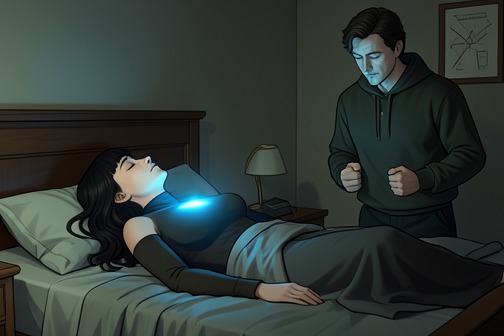
[Maggie's Wormhole Consciousness Ejection](entity:event-recall-event-maggie-s-wormhole-consc-7d10d839a523) is the distinctive consequence of Maggie's passage through an artificial wormhole: because she is a Class-3 cosmic entity from outside the reality she is entering, transit repeatedly detaches her consciousness from her vessel. Her body remains present and functional enough to move, but the person Joe knows is absent. What begins as a frightening anomaly becomes a familiar procedure for the couple, yet its recurrence exposes how precariously their intimacy depends on a body that can be occupied without being inhabited.
## Causes and Conditions
Maggie explains that her consciousness is forcibly ejected whenever she crosses a wormhole because she is foreign to the destination reality and therefore easily detached from it. The problem is not ordinary unconsciousness or physical injury. Her vessel arrives, but the animating consciousness does not remain securely joined to it. The distinction matters because Maggie’s body continues to breathe, stand, and respond to prompts while lacking her recognizable speech, expression, and active presence.
The first fully observed instance occurs aboard a ship preparing for a jump. Joe notices Maggie hover-sitting nearby with her eyes closed and her hairtacles flailing, apparently engaged in an activity he does not understand. When artificial gravity fails, both travelers drift upward, but Joe’s concern centers on Maggie’s safety. The generated wormhole produces a bizarre sound and several seconds of total sensory deprivation; when sensation returns, gravity throws Joe against the bed and Maggie heavily onto the floor.
## The First Ejection
Joe initially sees signs that something is wrong beyond the fall. Maggie’s skin is warm rather than ambiguously tempered, the swirling un-light has vanished from her eyes, and her hair has become completely still. Her pitch-black irises follow Joe’s movements, but not through ordinary eye movement: her entire head tracks his waving hand and snapping fingers. She can rise when he helps her up, yet she offers no speech and no independent action. The familiar body is therefore transformed into an unsettling object that looks back without communicating.
Joe’s explanation is speculative and shaped by his media-saturated imagination. He wonders whether Maggie’s body arrived while her brain was somehow lost in transit, leaving an autopilot in control. Even though he recognizes that the idea is absurd, he acts on the only practical intuition available to him. He holds her head and kisses her on the lips. The kiss produces the familiar sensation of something passing from his throat into her, and within a few breaths Maggie returns, complete with her swirling eyes and wriggling locks.
Maggie confirms that Joe has correctly identified the problem: her consciousness was forcefully ejected from her vessel during the wormhole crossing. She is impressed that he solved it faster than expected and assures him that she is fine. The scene reverses the apparent hierarchy between them. The immortal Class-3 entity possesses the greater knowledge and durability, but Joe, the ordinary human, recognizes the immediate relational remedy and restores her presence through physical intimacy rather than technical expertise.
## Recurrence and Routine
The event does not remain unique. During a later journey, [The Queen Mary](entity:object-recall-object-the-queen-mary-0b7a04ff18e0) docks with a freighter so that the yacht can use another wormhole. Passengers are ordered to strap themselves in because artificial gravity will be disabled. Joe and Maggie sit in their cabin while automated belts and cuffs secure them; after the characteristic wormhole sound and the return of gravity, Joe again finds Maggie spacing out with dull eyes and motionless hair.
By this point the sequence has become commonplace. Maggie’s consciousness generally returns on its own after about fifteen minutes, while Joe expedites the process with a kiss. The gesture is unnecessary in the strictly practical sense, because her consciousness would eventually re-enter the vessel, but it is welcomed by Maggie and has become part of their shared transit ritual. Repetition changes the meaning of the original horror: what first resembles possession or bodily death becomes an expected danger of travel, handled through patience, observation, and a familiar act of affection.
The recurrence also preserves the event’s disturbing edge. Joe still checks whether Maggie is all right, because the vessel’s outward continuity cannot guarantee the return of the person within it. The couple’s routine depends on a paradox: the incident is predictable enough to manage but never so harmless that Joe stops fearing the sight of Maggie absent from herself.
## Effects on Joe and Maggie
Maggie’s ejection intensifies Joe’s attachment while revealing its vulnerability. Joe already spends much of his life in [V-Life](entity:location-recall-location-v-life-f6d3b624dedd) because the virtual platform gives him something to do in a post-scarcity society where his official record labels him unemployable. He defends that life as a genuine source of ease, social contact, and amusement rather than as a failure. Maggie’s physical absence, however, cannot be solved by distraction. A silent vessel beside him is not the same as the responsive companion he loves.
That dependence troubles Maggie. She fears that Joe’s openness and naivety make him susceptible to replacement by someone else, even while she acknowledges that those same qualities allowed him to admit an entity like her into his life and thoughts. The wormhole incident gives that fear a literal form: Joe can be beside Maggie’s body while Maggie herself is elsewhere. His bond is therefore emotional and embodied, but never fully secured by physical proximity.
[Barry Mulligan](entity:character-recall-character-barry-mulligan-a1eddd17d6d8) later warns Joe not to let Maggie become his entire world. He acknowledges that Joe was brave to travel so far to see his father, but insists that Joe was brought there and must begin being his own man instead of allowing others to guide him. The warning gains force after repeated ejections have made Joe’s caretaking role habitual. Joe promises to remain strong and look after Maggie’s vessel, but eventually admits that this is not enough and decides to take control of his own life.
## Consequences and Narrative Significance
Joe’s response culminates in a desperate attempt to summon Maggie rather than merely wait for her to return. He revives the [Cult of the Gazing Star](entity:organization-recall-organization-ed3f5ed2b919), reconstructs the ritual that originally summoned [Magh'rathlak the Observer](entity:character-recall-character-magh-rathlak-the-ob-569fc2868ffe) into this reality, and gathers forty-two robed participants around an altar. Using notes, recordings, and comments left by the entity, he determines the required planetary alignment, chants, props, and devices. His plan is the most extreme consequence of the ejection: a temporary transit problem has become a crisis of separation severe enough to justify exploiting desperate and unstable recruits in the hope of drawing Maggie out.
The event thus links technological infrastructure with metaphysical instability and personal desperation. V-Life can provide Joe with an artificial world whose senses are flawlessly stimulated, while a wormhole can carry a body across interstellar space but fail to carry the consciousness that makes that body a person. The contrast gives the incident its central significance. In this story, embodiment is neither secure nor self-evident; it can be simulated, interrupted, occupied, or recovered, and love becomes the force that recognizes the missing person and attempts to call that person back.
Maggie's Wormhole Consciousness Ejection also marks a value shift from passive comfort to active commitment. Joe once accepted an uneventful, consequence-free life and found virtual entertainment sufficient. After Maggie’s recurring absence, he cannot remain content merely to wait beside an empty vessel. His kiss restores her in the immediate scene, but his later ritual shows that the deeper problem is not only how to revive her body. It is how to act when the person he loves can be physically present yet existentially elsewhere.
Event 7
The Pale Goddess Cult Formation
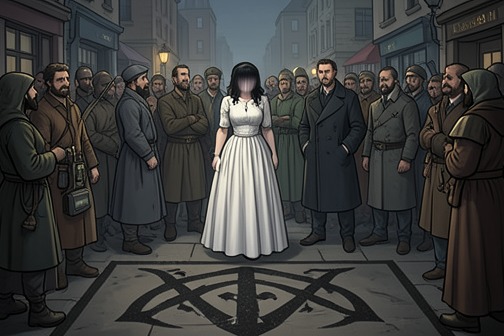
[The Pale Goddess Cult Formation](entity:event-recall-event-the-pale-goddess-cult-f-9262f967a9ac) marks the point at which admiration for Maggie ceases to be merely private enthusiasm and becomes a social force with its own name, members, mythology, and capacity for violence. The movement grows from public fascination with Maggie, especially the viral presentation of her [Lancaster-3](entity:location-recall-location-lancaster-3-bc5178e24cb6) copyright trial, but its development is also shaped by the [Supernatural Eviction Agency](entity:organization-recall-organization-1fbafc4808b3)’s covert manipulation. Its importance lies in the collision between fan culture and genuine religious organization: Joe calls it a fan club, Maggie treats it as a dangerous cult, and the surrounding institutions respond as though a new political and supernatural threat has emerged.
## Origins in Public Fascination
The movement’s immediate popular label is “The [Pale Goddess](entity:expression-recall-expression-pale-goddess-a5e5fb0db649),” a title attached to Maggie by people discussing the trial online. The name is not created through a formal revelation or doctrine. It spreads through the neighborhood message boards after a highlight reel of the Lancaster-3 proceedings becomes viral, reportedly within an hour. Joe initially assumes that [Eugene Charles](entity:character-recall-character-eugene-charles-8ff8be13c4a5) must have produced and distributed the video, since he was the only nearby person with both access to the trial and a plausible reason to circulate it. The rapid spread of the footage turns Maggie’s public appearance into a spectacle and gives strangers a shared image around which to gather.
The audience’s admiration is inseparable from its hostility toward Joe. The message-board discussions praise Maggie as “The Pale Goddess,” but many participants attack Joe as an ordinary, unsuitable boyfriend who supposedly has no right to be with her. Their comments range from contemptuous to malicious, and the self-proclaimed admirers present themselves as more deserving partners. The movement therefore begins with a possessive form of identification: its members do not simply admire Maggie from a distance, but judge her relationship and claim a voice in who may stand beside her.
Maggie’s appearance makes that process even more volatile. Dolores Castlebridge condemns her hair, eyes, skin, and alleged dependence on gene-modifications, insisting that she barely looks human. Maggie rejects the idea that anyone else may determine how her body should appear, asserting that only she and Joe have authority over it. The confrontation exposes the same mechanism later visible in the cult: outsiders convert Maggie’s body into a public object, then treat their interpretation of it as a legitimate basis for control.
## From Fan Club to Cult
Joe first learns that the movement has become dangerous when Maggie explains that the men who accosted him outside the elevator belong to it. Seven men around his age, all with similarly unhealthy physiques but far more aggressive demeanors, wait for him after he retrieves [Jeeves](entity:character-recall-character-jeeves-992311b84a7a) from maintenance. Their insults and coordinated hostility convert online resentment into physical intimidation. The incident gives the supposed fan club an organized face and demonstrates that its fixation on Maggie has consequences for anyone perceived as standing between her and its members.
Maggie estimates that the group has approximately one hundred and twenty thousand members and is expanding rapidly. That scale changes the meaning of the word “cult.” Joe recognizes that a following of that size could become a religion, while Maggie focuses on the threat posed by its growth. Joe objects that the organization is only a fan club, but the objection is semantic rather than reassuring. The group has already developed a collective identity, a revered figure, an enemy in Joe, and enough members to function as a mass movement.
The formation is also connected to the machinery of publicity. Joe finds dozens of message-board topics, each with hundreds of comments, surrounding the highlight reel. The video itself is less alarming to him than the reaction it generates, because the sheer volume of discussion shows that Maggie’s image has become reproducible and portable. Public attention no longer depends on Maggie’s presence. Once the image circulates, strangers can elaborate it, defend it, and weaponize it without her participation.
## Institutional Manipulation and Escalation
The movement’s growth is not entirely spontaneous. Joe, [Sarah Johanson](entity:character-recall-character-sarah-johanson-2ba6cdf5a75d), and Maggie eventually determine that the Supernatural Eviction Agency orchestrated the highlight reel and arranged for it to reach the local boards so quickly. Maggie investigates through the eyes appearing within her coiling hair and uncovers the Agency’s efforts to conceal its involvement. The discovery reveals that the cult’s formation is partly the product of an institutional operation rather than a simple grassroots response to a charismatic figure.
The Agency’s motive is connected to [Damian Benett](entity:character-recall-character-damian-benett-aa726cd249fd)’s attempt to exploit a manufactured violation in order to void Maggie’s contract and renegotiate it on more favorable terms. Sarah’s experience working under [Oliver Millington](entity:character-recall-character-oliver-millington-acc358be94d6) allows her to recognize the likely strategy: create a public or contractual problem, use it as leverage, and force a new arrangement. The plan is reckless because it treats Maggie’s public image as an administrative instrument while underestimating the power of a Class-3 cosmic entity. The Agency’s manipulation thus helps create the very mass devotion that makes Maggie harder to govern.
The episode also shows how official labels intensify the danger. Before Maggie’s identity is fully understood, the Agency has almost no intelligence on [Magh'rathlak the Observer](entity:character-recall-character-magh-rathlak-the-ob-569fc2868ffe), despite records of enthrallment, disintegration, matter manipulation, and mental corruption across seven minor incidents. Agent Johanson’s report identifies the entity as Class-3 and notes no known history of using lesser entities as proxies or serving higher-class beings as one. The Agency’s uncertainty encourages containment and surveillance, while the public’s fascination encourages worship. Both responses turn Maggie into a category before they understand her as a person.
## Ritual Form and Religious Precedent
The Pale Goddess movement echoes the older [Cult of the Gazing Star](entity:organization-recall-organization-ed3f5ed2b919), though the two formations arise in opposite directions. The Cult of the Gazing Star deliberately seeks to summon Magh'rathlak the Observer and intends to end the universe as a way of leaving its mark upon an uncaring cosmos. Its members rely on desperation, manipulation, ritual repetition, and human sacrifice, binding a young man to a stone altar while chanting “Hoom ge’sore, ihm ge’sara.” A sinister parchment appears as part of the summoning process, and Joe ultimately signs a contract in his own blood after requesting that it be moved within reach of his handcuffed arm.
The later cult formation reverses that pattern. Maggie does not initially seek worshippers, and Joe does not begin with a formal religion in mind. Nevertheless, the fan movement inherits the older cult’s vocabulary of devotion, sacrifice, and dangerous access to the supernatural. The contrast is deliberately comic and unsettling: one organization summons a cosmic entity through an explicit ceremony, while the other develops from a viral video and an argument over who is worthy to date Maggie. Yet both treat an extraordinary being as a means of escaping ordinary insignificance.
This resemblance becomes literal when Joe later revives the Cult of the Gazing Star to summon Maggie back after her departure. He reproduces the original ritual using notes, recordings, and comments left by the entity, while Maggie’s vessel helps transfer those materials to digital form. He learns the required planetary alignment, chants, props, and devices, then gathers precisely forty-two participants in dark red robes embroidered with gold and marked by three vertical eyes arranged in a triangle. The later ceremony demonstrates how quickly the Pale Goddess phenomenon has become entangled with the older ritual tradition: fan devotion provides the social energy, while the Gazing Star supplies the supernatural template.
## Consequences and Narrative Significance
The cult formation places Joe in a new and humiliating position. He is not merely Maggie’s partner but the movement’s symbolic obstacle, a plain man whom online admirers believe has usurped a place meant for them. Their resentment becomes sufficiently organized that a group confronts him in person, while Joe’s attempt to dismiss them as “all talk” is immediately disproved by the armed hostility waiting at the elevator. The movement therefore makes his relationship public in the most intrusive way possible and turns intimacy into a matter of collective dispute.
For Maggie, the formation is a violation of agency. She has already resisted other people’s attempts to define her body and identity, and the cult repeats that intrusion at a larger scale by converting her into an icon. Its adherents worship an image they do not control, while the Agency manipulates that image for contractual purposes. Maggie’s ability to see through the Agency’s concealment prevents the public narrative from remaining entirely outside her grasp, but the estimate of one hundred and twenty thousand members shows that knowledge is not the same as control.
The movement also creates a risk of escalation beyond ordinary fandom. Sarah fears that Maggie might respond to Oliver Millington’s scheme by erasing him from existence, and she urges restraint because his misconduct does not justify such a response. That fear is grounded in the same transformation that produced the cult: a public image has become attached to a being capable of extraordinary acts. The followers’ worship, the Agency’s manipulation, and Maggie’s actual power reinforce one another until a media spectacle can generate a supernatural emergency.
The formation’s final irony is that its apparent object, Maggie, is temporarily unavailable to return to reality. When commandos later interrupt Joe’s ritual, they know Magh'rathlak the Observer through Maggie’s human alias, Mags Oh, and they possess an “insurance” arrangement stating that the Class-3 entity cannot immediately return and would communicate when cooperation could resume. The commandos intervene because they cannot know what might emerge from the dimensional rift, not because they expect Maggie herself to appear. The Pale Goddess cult has therefore outgrown its supposed goddess: it continues organizing, threatening, and summoning even when the entity at its center has not consented to any of it.
Event 8
Joe and Maggie's First Sexual Encounter

[Joe and Maggie's First Sexual Encounter](entity:event-recall-event-joe-and-maggie-s-first-419554df866b) marks the point at which their negotiated bond becomes a consummated romance. The scene is not an isolated seduction: it follows an arrangement in which [Magh'rathlak the Observer](entity:character-recall-character-magh-rathlak-the-ob-569fc2868ffe), living through Maggie's human form, offers to bind itself to Joe as his guardian while asking him to serve as its guide and anchor in reality. Joe translates that formal proposal into the language of partnership, and Maggie accepts that a mate-like relationship is possible. Their first sexual encounter therefore joins protection, dependence, curiosity, and desire in a relationship that had initially been framed as an exchange of care and knowledge.
## Causes and Background
The encounter grows out of a relationship already shaped by unequal abilities and reciprocal need. Maggie can alter Joe's circumstances, improve his technology, and protect him from dangers that would overwhelm an ordinary human; Joe, by contrast, provides a human point of reference through which she can study everyday reality. Her proposed binding promises to guard and nurture his fragile being, while making him her guide and anchor. That arrangement gives their intimacy an unusual contractual and cosmic foundation, but the surrounding scenes show that it has also acquired genuine emotional force.
Joe's ordinary life makes the contrast especially sharp. He describes himself as having received an “Unemployable” record after poor aptitude-test results and accepts a low-pressure existence in which virtual reality supplies much of his social life and entertainment. Maggie, meanwhile, is a Class-3 cosmic entity whose abilities and understanding vastly exceed his own. The encounter does not erase that imbalance, but it gives Joe a form of closeness that is not merely the result of being protected, employed, or entertained by a superior being.
The emotional pressure is heightened by Maggie's anxiety about the durability of human attachment. She admits that she does not fully trust Joe because his optimism, gullibility, and openness allowed her into his life so easily; those same qualities, in her view, might allow someone else to replace her. Her fear rests on an awareness that friendships, rivalries, and romances can all change with time. The first sexual encounter consequently functions as both fulfillment and exposure: it confirms the strength of their present bond while taking place against Maggie's knowledge that no human relationship is guaranteed permanence.
## What Happens
The event takes place aboard the [Silver Tempest](entity:object-recall-object-silver-tempest-47d5261f5397) after Joe asks Maggie to stop the vessel. She activates the shuttle's warning beacon as required by law, and once the ship has come to a complete halt, she joins Joe in their shared cabin. He sits on the double bed and signals for her to sit beside him. Before she can ask what he wants, he abruptly kisses her and presses her down onto the bed.
Joe's action is unusually forceful and uninhibited compared with his normally passive manner. He holds Maggie tightly and kisses her with an intensity that the narration compares to a caged, starving beast finally released. The physical immediacy of the moment carries what the pair has not fully articulated in conversation: Joe's desire has accumulated beneath the routines of cohabitation, work, travel, and mutual care, and now moves faster than explanation.
Maggie does not merely tolerate the advance. She welcomes it, has been anticipating it for some time, and responds with equal enthusiasm. The encounter is therefore presented as reciprocal rather than as a one-sided exercise of Joe's initiative. Her consent is expressed through active participation, and the scene culminates in the explicit statement that Joe and Maggie make love for the first time, with the possibility of future encounters left open by the narration.
## Relationship and Value Shift
The scene changes the status of the relationship from suggestive partnership to consummated romantic union. Earlier, Joe could treat Maggie's presence as an extraordinary form of companionship and assistance; afterward, their bond has crossed into a shared sexual life. The value at stake is not simply pleasure but recognition. Joe is no longer only Maggie's dependent, employee, student, or anchored human guide, and Maggie is no longer only his protector, employer, teacher, or supernatural companion. Their bodies establish a new mutuality that their formal arrangements alone could not provide.
That mutuality remains complicated. Maggie's power, origin, and capacity for manipulation are never removed by intimacy, while Joe's dependence on her remains visible in his living arrangements, finances, work, and travel. His father, [Barry Mulligan](entity:character-recall-character-barry-mulligan-a1eddd17d6d8), later points out that Joe lives in Maggie's apartment, relies on her salary, was flown to the mining station aboard her shuttle, and has begun eating and working differently for her rather than for himself. Joe admits that this criticism may be valid. The sexual encounter thus deepens a bond that is loving but also structurally unequal, making the later question of Joe's independence more urgent rather than resolving it.
## Consequences and Aftermath
The encounter helps explain why separation becomes so devastating for Joe. When Maggie is absent or inaccessible, he misses not only an abstract cosmic intelligence but the person whose voice, smile, body, and shared domestic life had become central to him. His later attempt to take control of his life is explicitly connected to his promise to Barry and to his inability to remain sustained by Maggie's vessel alone. He prepares repeatedly, fails twice, and resolves that the third attempt must succeed.
That effort culminates in Joe's desperate decision to revive the [Cult of the Gazing Star](entity:organization-recall-organization-ed3f5ed2b919) and reproduce the ritual that originally summoned Magh'rathlak the Observer into reality. He uses Maggie's surviving notes, recordings, and comments to reconstruct the required planetary alignment, chants, props, and devices, then gathers forty-two robed participants around an altar. Although he knows that many recruits are desperate, mentally disturbed, easily manipulated, or dangerously foolish, he accepts the moral ugliness of exploiting them because he believes Maggie's return would make the risk worthwhile. The first sexual encounter is therefore part of the emotional cause of a later escalation: once physical intimacy has made their bond tangible, losing Maggie drives Joe toward deliberate, dangerous action.
The event also clarifies why Maggie's care can feel both comforting and threatening. She upgrades Joe's technology, offers to protect and nurture him, and becomes the center of his life, yet her overwhelming competence risks turning care into dependency. Joe's later resolve to act for himself does not reject Maggie; it attempts to preserve the relationship without allowing it to consume his entire identity. In that sense, their first sexual encounter is both a romantic consummation and an early warning about the costs of being loved by a being powerful enough to organize another person's world.
## Narrative Significance
As a romance beat, the encounter is the midpoint transformation from closeness into acknowledged physical partnership. Its suddenness contrasts with the long preparation beneath it: Maggie has already proposed a binding, Joe has already recognized her as a potential mate, and their shared life has already made ordinary boundaries increasingly porous. The scene converts that latent possibility into an irreversible fact of their history.
Its significance is heightened by the book's comic and speculative setting. The lovers' path to intimacy runs through cosmic entities, military authority, altered bodies, enhanced machines, virtual dependence, and legal or institutional secrecy rather than through a conventional courtship. Yet the decisive movement is recognizably human: one partner fears being replaced, the other fears losing the relationship, and both respond through closeness. The encounter makes the fantastical premise emotionally legible while preserving its central contradiction: Joe finds meaning and confidence through Maggie, but must eventually learn to choose and act without surrendering his entire self to her protection.
Event 9
Joe's Astrohodophobia Exposure Therapy

[Joe's Astrohodophobia Exposure Therapy](entity:event-recall-event-joe-s-astrohodophobia-e-c2fbd2d76b4b) is a decisive turning point in [Joe Mulligan](entity:character-recall-character-joe-mulligan-97d1f45a6068)'s life: a staged confrontation with spaceflight that transforms his fear from an immovable limitation into a challenge he can meet through consent, companionship, and repeated experience. The treatment is conducted by Maggie during an interstellar cruise, and its success is measured not by the disappearance of fear in the abstract but by Joe's ability to remain present, think clearly, and act when the vacuum is no longer merely imagined.
## Causes and Therapeutic Principle
Joe's astrohodophobia is severe enough that the prospect of spending three months in space leaves him visibly shaken and convinced that the voyage could worsen rather than cure him. Maggie explains that the cruise is part of cognitive behavioral treatment, specifically desensitisation or exposure therapy: Joe must face the feared situation in order to overcome it. He rejects the possibility of having Maggie simply remove the phobia from his mind, partly because he does not want her to alter the mental qualities that helped form their relationship. The treatment therefore respects his wishes and preserves his agency, even though Maggie possesses abilities that could have made a more immediate intervention possible.
Joe's own account of his life clarifies why this struggle matters. He describes himself as neither strong, fast, nor intelligent, and recalls graduating with such poor aptitude-test results that his record marked him as “Unemployable.” He does not present this as a hidden heroic destiny waiting to be uncovered. Instead, he values a life free from excessive worry and finds that virtual reality offers him an easy way to socialize and enjoy himself. Maggie's treatment challenges that settled accommodation without denying the legitimacy of Joe's limitations. It asks him to expand the life he has accepted, not to become a different kind of person.
## Early Exposure Aboard the Cruise
The first stage places Joe in the observation deck, where the ship's reinforced glass ceiling offers an even split between the planet below and the cosmos beyond. The setting is intended to be romantic for the other passengers, but Joe experiences it as an encounter with the unforgiving vacuum. He needs Maggie to assure him repeatedly that no harm will come to him before he can even leave the hallway. Once inside, he lies with his head in Maggie's lap so that he can look toward space while keeping her reassuring expression in view. The arrangement is strange to outside observers, yet it allows him to calm somewhat after several minutes.
For the first few weeks, stargazing becomes the couple's routine. Joe remains in varying states of panic while Maggie soothes and monitors him, hoping that steady exposure will gradually make spaceflight familiar. The process is improvised as much as clinical. Maggie has extensive knowledge of psychology and can manipulate minds, but she is not a psychiatrist, and she recognizes that delicate therapeutic methods are outside her usual expertise. Her interest in learning from the process coexists with a clear priority: Joe's mental health and continued ability to function must come first.
The treatment also exposes the danger of excessive information without sufficient emotional preparation. When Joe asks about micrometeorites, Maggie explains that, without the ship's kinetic barrier, impacts could cause explosive decompression and pull every passenger into space within minutes. Her technically accurate lecture sends Joe's complexion and expression back toward the panic of the first voyage. He manages to regain some control through long breaths and rational thought, but the episode shows how easily knowledge can become another form of terror when the imagination supplies the missing disaster.
## The Space Walk
After witnessing [Kelogh’theryl the Devourer](entity:character-recall-character-kelogh-theryl-the-d-6ea10c0eef3f)'s emergency evacuation into space, Joe begins to show a more favorable response to stargazing. Maggie observes him for several days to make sure the improvement is not a temporary calm or a relapse waiting to happen. Once she is satisfied, she proposes the final and most demanding step: a space walk together. Joe accepts, despite the anxiety that rises during the half-hour preparation in the airlock aboard the ship orbiting [Crumbstone-7](entity:location-recall-location-crumbstone-7-7bd4bcb5dee4).
The preparation gives the fear a concrete structure. Joe and Maggie receive lightweight suits and helmets, while a service automaton checks their equipment and repeats basic safety instructions, including not puncturing the suit or disconnecting the tether. When the air is pumped out and the hydraulic doors open, Joe hesitates at the threshold and appears paralyzed. Maggie grips his shoulder and reminds him that he has nothing to fear. He takes additional breaths, gathers himself, and kicks away from the airlock. For the first time, he is not looking at space through glass or imagining it from a cabin; he is floating in it.
The crucial reversal happens immediately after entry. Shock and anxiety give way to a light-hearted sense of freedom. Zero-gravity movement proves intuitive because Joe's implants transmit his thoughts to the suit, which directs tiny jets on his backpack and compensates for much of his uncontrolled movement. The ship supplies air, power, and fuel through the tether tube, while redundant safety systems reduce the practical danger. Joe had been told about these protections before, but his subconscious had not accepted them until he experienced them directly. Once doubt gives way to firsthand knowledge, he darts and rolls through space with the delight of a child discovering a new physical law.
Maggie remains central without claiming ownership of the achievement. Joe initially forgets to share his excitement with her because he is so absorbed in the experience, then turns toward her and briefly freezes again. When he considers whether she should wear her space suit, he ultimately tells her, “You’re perfect just as you are.” Maggie kisses his visor, and the pair return inside to make out, leaving her lipstick on Joe's visor for a confused technician to discover. The comic aftermath does not diminish the therapeutic climax; it places the victory inside their ordinary intimacy, where fear, affection, embarrassment, and play coexist.
## Consequences and New Agency
The exposure therapy succeeds because Joe's relationship with Maggie supplies reassurance without replacing his own action. She guides the sequence, explains the method, monitors his condition, and provides physical and emotional support, but he must repeatedly choose to remain in the feared environment. At the airlock, her hand helps him cross the threshold; it does not carry him through. The achievement belongs to the cooperation between them, while Joe's decision to move forward supplies its decisive force.
The practical consequence is substantial. Joe would not have been able to reach the remote mining station where [Barry Mulligan](entity:character-recall-character-barry-mulligan-a1eddd17d6d8) is serving an around-the-clock sentence without a private shuttle and substantial space walking. Before the treatment, such a journey would have left him too frightened to conduct the difficult conversation awaiting him. After the space walk, he is ready to travel far enough to visit Barry, and the later meeting gives him an opportunity to hear his father's admission that he had lied to Joe for most of his life. Barry also warns him to become his own man rather than allowing Maggie to become his entire world. Joe's newly acquired ability to cross space therefore leads directly into a second test of independence: confronting his father and reconsidering how much of his life is being directed by others.
The accomplishment also alters the balance of Joe and Maggie's partnership. Maggie has protected and nurtured him since binding herself to him as his guardian, while Joe serves as her guide and anchor in reality. During the treatment, however, she refuses to describe his recovery as her achievement. Joe overcomes the phobia through his own will and determination, even though her care makes that determination possible. This distinction becomes especially important after Maggie is absent from her human vessel. Joe continues trying to protect it, but eventually realizes that caring for the vessel is not enough; he must take control of his own life. The confidence gained through exposure becomes part of the resolve that later drives him to attempt the [Cult of the Gazing Star](entity:organization-recall-organization-ed3f5ed2b919)'s summoning ritual in the hope of bringing Maggie back.
## Narrative Significance
The event gives physical form to a wider conflict between dependence and self-determination. Joe begins as someone who has accepted a low-pressure, VR-centered existence and who believes that he was not born for anything important. His fear of space reinforces that settled identity by making the wider universe literally inaccessible. The cruise gradually changes the meaning of space: first an overwhelming threat beyond reinforced glass, then a subject of anxious explanation, and finally an environment in which Joe can move freely under his own mental command.
The treatment also contrasts with Maggie's more coercive capacities. As a powerful supernatural entity, she could alter minds, but Joe's refusal to have the phobia removed establishes a boundary around their intimacy. The exposure process treats fear as a lived condition that must be negotiated rather than as defective information to be deleted. Its success depends on consent, repetition, reliable safety, and a trusted attachment. In that sense, the space walk is both a therapeutic endpoint and a declaration that Joe's vulnerability does not cancel his capacity for choice.
By the end of the episode, Joe has not become fearless in a simplistic sense. Earlier explanations can still provoke panic, and the treatment requires careful pacing, reassurance, monitoring, and a final push only after weeks of gradual acclimatization. What changes is his relationship to fear. He can breathe through it, test the reality beneath it, accept the protections available to him, and act anyway. That is why Joe's [Astrohodophobia](entity:state-recall-state-astrohodophobia-193c2590e942) Exposure Therapy matters beyond the cruise: it converts a private phobia into the first clear evidence that an apparently ordinary and dependent man can deliberately enlarge the boundaries of his own life.
Event 10
Kelogh'theryl's Visit and Ejection into Space

[Kelogh'theryl's Visit and Ejection into Space](entity:event-recall-event-kelogh-theryl-s-visit-a-e06a1eb0c376) begins when Maggie warns Joe that her sibling is coming to visit. Joe responds with an unusually practical gesture, ordering fish and chips not only for himself and Maggie but also two portions for the expected guest. The visitor’s arrival immediately overturns that domestic expectation. [Kelogh’theryl the Devourer](entity:character-recall-character-kelogh-theryl-the-d-6ea10c0eef3f) appears in the form of a striking blonde woman with fair skin, piercing blue eyes, wild hair, exaggerated feminine features, a pointy-toothed grin, and golden locks that form snapping, maw-like shapes of their own accord. The body is not merely a disguise: it is a temporary human vessel occupied by an entity whose appearance makes the boundary between attractive person and monstrous appetite impossible to ignore.
## Family Visit and Hidden Nature
The encounter is framed as a sibling reunion, but Joe quickly discovers that ordinary family language cannot contain what has entered the apartment. Kelogh’theryl explains that she is borrowing the body while its owner sleeps, and Maggie identifies the condition plainly as possession. This arrangement makes the host both present and absent: her body receives the visitor’s agency while her own consciousness is unavailable. The scene therefore places a vulnerable human body beneath the surface of a supposedly casual social visit, while Kelogh’theryl treats embodiment as an available resource.
The family connection also exposes Joe’s history with Maggie. When Kelly asks how he became involved with a cosmic entity, Maggie gleefully recounts that Joe volunteered as the offering in a summoning ritual without recognizing what he had agreed to. He had skimmed the cult’s brochure and simply accepted whatever followed. The anecdote makes his earlier recklessness part of the sibling’s first impression of him, while also explaining why the visitor finds him amusingly suitable as a potential meal.
## Possession and Escalation
The situation becomes dangerous when Kelogh’theryl’s host body changes before Joe’s eyes. The host’s natural dull-green eyes shift to Kelly’s sky-blue color, and the rest of the Devourer emerges within moments as the blonde bombshell seen at the door. The transformation is presented as efficient rather than ceremonial: face, hair, and figure expand into the entity’s preferred form, followed by a toothy grin and a predatory advance. The body functions simultaneously as a human disguise, a stage for monstrous manifestation, and an instrument of physical coercion.
Kelogh’theryl then attacks Joe by leaping onto his lap, wrapping her arms around his head, pressing him into her cleavage, and rubbing against him while taking pleasure in his involuntary physical response. Joe attempts to stop her, but his resistance does not alter her conduct. Her question about why she should stop makes clear that the encounter is governed by appetite and entitlement rather than mutual desire. The erotic imagery is consequently inseparable from menace: the exaggerated body that first produced astonishment becomes the immediate means of restraint and threat.
## Azgod’Kalar’s Intervention
Joe is unable to reach Maggie because his wrists are fastened to the chair, while Maggie remains unconscious and her vacant host body cannot intervene. His attention turns desperately to Azgod’Kalar, the small ball python accompanying Maggie. The serpent quietly moves from behind Maggie’s neck, across her shoulder and down her arm, then coils around her wrist. Its apparent calm contrasts with Joe’s panic and Kelly’s growing anticipation.
Azgod’Kalar recognizes the relevant control and uses its tail to press the button beside Maggie’s fingers. The action appears at first to be an attempt to release a restraint, but it activates something far more drastic. A loud rupture at the window is followed by a violent rush of air as the reinforced glass and every unsecured object in the cabin are sucked into space. The pet survives by wrapping itself around Maggie’s wrist; Joe and Maggie survive because their seats are fixed to the floor. Kelogh’theryl, unable to brace herself, is catapulted into the void along with furniture and the body she is inhabiting.
The ejection is both an emergency escape and a controlled trap. Maggie later reveals that she had hacked systems, crossed wires, and implanted instructions in Azgod’Kalar as a failsafe. Her tampering initially prevented Joe’s seat from releasing, ensuring that he would not be pulled into the breach, and it protected both him and the serpent during the decompression. The apparent accident is therefore the result of Maggie’s advance preparation, although she admits that she wanted to give her sibling a chance rather than simply destroy or imprison her.
## Aftermath and Significance
A metal shutter seals the breach almost immediately, and the cabin’s atmospheric systems restore the air within seconds. Joe nevertheless suffers a renewed attack of astrohodophobia after the sudden exposure to space. Once he can move, he shakes Maggie awake; the familiar sensation of his consciousness or power passing through his touch restores her swirling eyes and awareness. Maggie then helps him to the bed frame and recreates pillows and a mattress through telekinesis after the originals have vanished.
Joe’s immediate reaction is frantic disbelief that Kelly could have done something so profoundly stupid, followed by concern for the human host. He objects that the woman whose body was being used had not chosen the danger, even though Kelogh’theryl was a Class-3 cosmic entity. Maggie apologizes and explains that the evacuation was intended to give her sibling an opportunity while preventing harm to the others. The apology does not erase the violence of the solution, but it establishes the limits of Maggie’s protective planning: she can engineer survival with extraordinary precision, yet the method still turns a human body and a spacecraft cabin into pieces of a larger tactical arrangement.
The event’s wider force comes from its collision of domesticity, embodiment, and cosmic hierarchy. A meal ordered for a visiting relative becomes the setting for possession, assault, and explosive decompression. Maggie’s human presentation is shown elsewhere to be a deliberate vessel under continuous training: she studies breathing, blinking, walking, and facial expression in order to master human behavior, and her form is designed to blend into society. Kelogh’theryl’s possession exposes the darker counterpart of that process. Where Maggie uses a body to learn restraint and attachment, the Devourer uses one to pursue appetite. The episode therefore makes the human body a disguise, a social interface, a target, and finally something carried helplessly into the void.
Event 11
Joe's Visit to Barry Mulligan
[Joe's Visit to Barry Mulligan](entity:event-recall-event-joe-s-visit-to-barry-mu-1aa8ad1ab833) is the long-delayed meeting between [Joe Mulligan](entity:character-recall-character-joe-mulligan-97d1f45a6068) and his father, [Barry Mulligan](entity:character-recall-character-barry-mulligan-a1eddd17d6d8), whose absence from family life had been explained to Joe as voluntary deep-space mining. The visit exposes that explanation as a lie, but it does not culminate in the furious confrontation Joe had imagined. Instead, Joe finds a father still capable of affection, apology, and practical guidance, while Barry recognizes in his son the same eagerness to please others that helped bring about his own imprisonment. The event therefore functions as both reconciliation and an interrupted inheritance: Joe receives not money or rescue, but a warning to become his own man before dependence turns into another form of confinement.
## Causes and Background
Joe travels with Maggie to visit Barry at the privately run mining operation where he is serving a thirty-year sentence of hard labor. The truth about that sentence has only recently emerged. Barry had intended to leave deep-space mining when Joe was born, but a major accident injured many people, cost millions of poundingtons, and led to Barry’s conviction on fifteen counts of gross negligence. Because Joe’s parents had concealed the circumstances, Joe grew up believing that his father had chosen work over his family and carried the resulting resentment for years.
The journey also occurs against a wider pattern of institutional concealment. Maggie’s arrest had been erased from the local police database after the [Supernatural Eviction Agency](entity:organization-recall-organization-1fbafc4808b3) ordered her release under military authority, and her diplomatic status later allowed her to escape the copyright lawsuit brought by [McLarson’s McLawyers](entity:organization-recall-organization-e4f3674a812a). Those surrounding episodes establish a world in which military command, diplomatic privilege, and bureaucratic secrecy can abruptly override ordinary procedures. Barry’s case is different but related: his life has likewise been determined by an institutional decision that Joe was not permitted to understand. The visit is consequently not only a private family encounter but also a confrontation with the human cost of official secrecy and punitive labor.
## Arrival and Reunion
The station initially seems less like a conventional penal facility than a private mining operation employing convicted but non-violent laborers. A bored security guard performs only a rudimentary scan, while his psionic sensor burns itself out attempting to read Maggie’s brain waves without her revealing the malfunction. The couple is then directed toward the dormitories, where Barry lives in a cramped, untidy room that has been hastily cleaned. Used paper plates and cups hidden beneath the bed preserve the unmistakable impression of a bachelor’s quarters, despite Barry’s marriage and family beyond the station.
Barry himself remains physically recognizable to Joe: tall, bald, clean-shaven, and broad-shouldered, dressed in stained old work clothes and heavy boots. He greets his son with an exuberant grin and a shouted welcome, then lifts him in an unreserved bear hug. The gesture immediately complicates Joe’s expectations. Barry is not encountered first as an abstract criminal or an absent father, but as an emotionally open parent whose instinct is still to embrace his child.
The reunion expands almost at once into a communal celebration. Barry is one of the station’s senior miners and has made friends throughout the workforce, so news of his son’s arrival spreads rapidly. Workers end shifts early to meet Joe and see Maggie, and the planned family lunch becomes an informal office party. The male miners leave Maggie largely undisturbed but warmly draw Joe into their company, recognizing in him the same humble, easygoing manner associated with his father. Maggie eventually returns to the shuttle so the men can relax, while retaining the ability to observe what happens from a distance.
The visit becomes so convivial that Joe remains for six hours beyond the expected rhythm of a formal family appointment. He joins a drinking contest, passes out, and must be transported back to the shuttle in a self-propelled cargo crate by a slightly tipsy security guard. The guard admits that the departure is already three hours late but treats the delay as a regrettable necessity rather than a serious offense. Joe wakes eight hours later with a severe headache, which Barry’s homemade sour-cabbage-tasting medicine cures within fifteen minutes. The comic excess of the celebration matters because it gives father and son an experience of shared pleasure rather than forcing their entire relationship to pass through accusation.
## Reconciliation and Gifts
Before the festivities end, Barry takes Joe aside for a private conversation and directly admits that he lied to his son for most of Joe’s life. Barry apologizes rather than minimizing the deception, and Joe accepts the apology immediately. That exchange becomes a central reason the visit feels successful: the truth is painful, but the father finally takes responsibility for having hidden it, and the son chooses not to make the confession a pretext for continued punishment.
Joe’s own change of heart has begun before he reaches the station. During the flight, he studies old photographs and videos of Barry and realizes that his anger has never been solely about the lie. Beneath it lies a simpler grief: he missed his father and had resented him for not being present. Once Joe understands that Barry’s absence was not entirely his own choice, he decides that the limited time available for the reunion is better spent together than consumed by an argument. The decision does not erase the parents’ betrayal; it distinguishes resentment over the deception from grief over the absence and allows Joe to respond to both honestly.
Barry’s gifts preserve the reunion in tangible forms. He gives Joe a small bottle of homemade hangover medicine, several mineral samples collected over the years for Maggie’s scientific interest, and a shoebox-sized parcel containing a holographic locket like the one owned by Joe’s mother. The locket holds dozens of images from the party, including one especially meaningful father-and-son photograph. Unlike the surrounding pictures, filled with silly faces and rough-featured miners, this image resembles a deliberate family portrait. Joe plans to frame it and display it at home, converting a spontaneous station gathering into a lasting record of belonging.
## Barry’s Warning
Barry’s most consequential contribution is not a gift but a lecture about dependence. He observes that Joe lives in Maggie’s apartment, relies on her salary, travels in her shuttle, and has begun eating properly and working for her rather than pursuing an independent direction. Joe initially resists the implication, then admits that Barry may have identified a concern he had already sensed and suppressed. The father urges him to take initiative, develop self-reliance, and learn to say no before life inevitably goes “tits-up.” Joe promises that he will try.
Barry’s advice is grounded in his own history rather than abstract wisdom. A colleague first asked him to cover half an hour of a shift because he was exhausted, offering a pint in return. Barry agreed despite his own fatigue, then repeated the favor when asked again. His reputation for being helpful caused other workers to transfer their responsibilities to him. They were not necessarily malicious; some were lazy, incompetent, or inconsiderate, but Barry could not bear to disappoint them and repeatedly added their work to his own. His efforts to keep up eventually contributed to the accident and the conviction that removed him from his family for decades.
That history makes Barry both a warning and a distorted reflection of Joe. His co-dependent eagerness to please helped produce the very separation he had hoped to avoid, while Joe’s similar habits have left him materially and emotionally dependent on Maggie. Barry therefore asks his son to be selfish in a limited, protective sense: not to exploit others, but to preserve enough agency to withstand crisis. Joe accepts the lesson as something owed to himself, not as a favor to his father.
## Consequences and Significance
Joe returns to Maggie with a headache, a locket, mineral specimens, a vivid set of party photographs, and a revised understanding of Barry. The journey does not restore the lost years or cancel Barry’s sentence. It does, however, replace a simple story of paternal abandonment with a more difficult account involving institutional punishment, parental deception, personal weakness, and genuine affection. Barry remains responsible for lying, yet he is no longer reducible to the absence that shaped Joe’s childhood.
The event also marks a quiet movement in Joe’s development. He enters expecting to express anger and leaves having practiced forgiveness without denying injury. He accepts his father’s apology, recognizes his own dependency, and promises to act with greater independence. The final father-and-son photograph gives this change a visual emblem: among the noisy images of strangers and drinking, one carefully recognizable bond survives. The visit’s importance lies in that modest permanence. Joe cannot recover the life he wanted with Barry, but he can decide what to do with the time, truth, and responsibility that remain.
Event 12
Maggie's Realignment and Departure
[Maggie's Realignment and Departure](entity:event-recall-event-maggie-s-realignment-an-47cda181e4c9) is the decisive rupture between Maggie and [Joe Mulligan](entity:character-recall-character-joe-mulligan-97d1f45a6068). The event converts their relationship from an extraordinary arrangement of mutual protection, guidance, and affection into an enforced separation: Maggie must return to the authorities of her own reality, while Joe is left with her vessel, her warning, and the unbearable knowledge that his presence helped produce the change that took her away.
## Causes and Judgment
Maggie's crisis grows out of the bargain that first joined the pair. She had offered to bind herself to Joe, guard and nurture his fragile being, and study reality through him; he would serve as her guide and anchor. That arrangement gave both characters something they lacked. Maggie gained an intimate route into human experience, while Joe acquired a protector and a companion who treated his ordinary life as worthy of close attention. Over time, however, the protective contract became an emotional attachment, and Maggie's observation of humanity became participation in it.
The judgment against her is not issued by a human government. Maggie explains that her actions, methods, and motives have been reviewed by one of her own kind, and that the verdict identifies her as deviant. Her earlier attempts to expose [Kelogh’theryl the Devourer](entity:character-recall-character-kelogh-theryl-the-d-6ea10c0eef3f) unintentionally exposed her own failures to her ultimate superior. The investigation concludes that she had gradually increased her concealment of truth and her willingness to bend rules after meeting Joe. At first she merely accepted metaphor and sarcasm as alternatives to literal factual statements. Later she used fabricated excuses and omitted information, moving from technical tolerance toward deliberate misdirection.
The charge is therefore more profound than simple dishonesty. As Maggie embraces human values and emotions, she increasingly departs from her original nature as a cosmic entity of order. The progression is gradual enough to escape the individual's notice. Her most serious failure is that she has neglected her calling as the Observer, choosing the familiar world around Joe over the unknown that she is supposed to investigate. Realignment is consequently imposed as a corrective measure: without it, Maggie risks becoming an aberrant entity.
## The Separation
Maggie presents realignment with her characteristic precision, refusing to classify it as either good or bad. It simply is. Yet the emotional cost becomes unmistakable when she identifies the one consequence relevant to her relationship: she must leave Joe Mulligan. She names Joe as the source of her deviancy, not because he deliberately corrupted her, but because proximity to him allowed affection, preference, concealment, and attachment to displace the impersonal discipline expected of her kind.
The announcement is especially devastating because it confirms two apparently opposing truths. Maggie cannot dispute the verdict, but neither can she dispute how deeply she has come to care for Joe. The authority judging her is so far beyond ordinary human institutions that even its name briefly distorts reality. When Maggie begins to speak it, colors collapse into black and white, objects become rigidly rectangular, sound turns into flat drones, and the minds of Joe Mulligan and [Sarah Johanson](entity:character-recall-character-sarah-johanson-2ba6cdf5a75d) are overtaken by pure logic. The disturbance vanishes almost immediately, leaving only the memory of having encountered the inevitability of a Class-5 entity of order.
Afterward, Maggie touches Joe's cheek and asks him to comprehend that the decision cannot be disputed. She admits that the outcome has been approaching for a long time and that she may have recognized it but ignored the possibility in favor of remaining beside him. The admission makes the departure both institutional and personal: the judgment is external, but Maggie's failure to anticipate it is bound up with her own choice to value intimacy over duty.
## Protection and Final Change
Before leaving, Maggie gives Sarah Johanson a thumb drive and identifies it as insurance for Joe's sake. The gesture extends her protective role even as the relationship itself is being severed. She cannot remain with Joe, but she still attempts to secure his position through Sarah and her superiors. The object becomes a material continuation of the bond, carrying a practical safeguard where Maggie can no longer offer direct presence.
The transformation is visible in Maggie's body and manner. She promises neither an easy return nor an indefinite reunion, and she warns Joe not to make promises he cannot keep when he says he will wait forever. Then the un-light fades from her eyes, her coiling hair falls limp, and her face settles into a neutral, thoughtless expression. The change does not merely remove her from the room; it strips away the expressive human incarnation through which Joe had known her. Her vessel remains, but the lively companion who smiled, spoke, and responded to him has been replaced by an emptied, mechanical presence.
That distinction becomes crucial in the aftermath. Joe tries to care for Maggie's vessel as he promised, yet breakfast with the returned body is an exercise in grief rather than companionship. She follows him silently, processes food methodically, and answers his casual remarks with deadpan one-word replies. At first her voice had soothed him; now hearing it only emphasizes her absence. The body is present, but Maggie as Joe knew her is not.
## Consequences for Joe
The departure exposes the imbalance between Joe's dependence on Maggie and his father's earlier warning that he must become his own man. [Barry Mulligan](entity:character-recall-character-barry-mulligan-a1eddd17d6d8) had told him that Maggie could mean the world to him without being allowed to become his entire world. Joe had resisted that lesson because Maggie was not simply a friend or partner: she was the person who had made his life feel purposeful, protected, and inhabited. Her removal forces the warning into immediate reality.
Joe's ordinary identity intensifies the loss. He describes himself as unemployable, unsuccessful in aptitude testing, and lacking the strength, speed, or intelligence that society rewards. His satisfaction with a low-pressure life and with [V-Life](entity:location-recall-location-v-life-f6d3b624dedd) had once seemed like a settled philosophy. He could accept being unimportant because virtual entertainment and easy social contact gave him enough comfort. Maggie's departure changes the meaning of that acceptance. What had been contentment now risks becoming paralysis, and the man who had preferred distraction must decide whether he can act without the person who made action seem worthwhile.
His first response is not passive mourning. Joe begins trying to take control of his life, despite his fear and repeated failures. He preserves Maggie's vessel, draws upon the notes and recordings she left behind, and prepares a plan to bring her back rather than merely wait for her. The effort is costly and has already failed twice, but he treats the third attempt as one that must succeed. In this respect, realignment produces an inversion of the usual heroic pattern: the supposedly ineffective ordinary man is pushed across a threshold not by ambition or talent, but by grief and attachment.
## The Attempted Return
Joe's response culminates in the revival of the [Cult of the Gazing Star](entity:organization-recall-organization-ed3f5ed2b919) and the reproduction of the ritual that originally summoned [Magh'rathlak the Observer](entity:character-recall-character-magh-rathlak-the-ob-569fc2868ffe) into reality. He cannot perform the ceremony from vague hope alone. Maggie's surviving notes, recordings, and comments provide the necessary instructions, while her vessel must be coaxed into transferring those materials to digital form. Joe learns the precise requirements, including the once-a-year planetary alignment, the chants, the props, and the devices needed for the ceremony.
The ritual gathers exactly forty-two figures in dark red robes embroidered with gold and marked by three vertical eyes arranged in a triangle. A chant repeats throughout the chamber as the participants assemble around a central altar. Joe recruits his father and friends, but fills the remaining places with people attracted by vague promises of happiness, including the desperate, mentally disturbed, easily manipulated, and dangerously stupid. He recognizes the exploitation involved and feels sorry for those he recruits, yet decides that recovering Maggie is worth the moral compromise.
This plan reveals the full consequence of the separation. Maggie's realignment is intended to restore her to the order and calling she abandoned, but it also leaves Joe with a newly awakened capacity for initiative. He does not become powerful, brilliant, or independent in the conventional sense. Instead, he acts despite lacking those qualities, converting the humility that once made him passive into determination. The departure therefore changes the value of the relationship without erasing it: Maggie is absent, but her teachings, records, promises, and protective arrangements remain active in Joe's decisions.
## Narrative Significance
The event is a conflict between two forms of order. The first is cosmic and categorical, demanding that Maggie remain an Observer rather than an emotionally involved participant. The second is human and relational, embodied in Joe's belief that care creates obligations that cannot be cancelled simply because an authority declares them improper. Maggie accepts the judgment because she is an entity of order, but her acceptance does not make the separation emotionally neutral. Her final tenderness and her insurance for Joe show that the very attachment condemned as deviance has also shaped the moral seriousness of her departure.
The episode also places intimate love beside systems of coercive authority seen elsewhere in the story. Sarah Johanson is compelled into military service because of her psionic potential, with desertion punishable through remote destruction of her implant. Maggie is not governed by human law, yet her own kind imposes a comparable discipline through classification and forced correction. Human institutions release Maggie from custody under military authority, protect her from interference, and grant her diplomatic privileges; the higher cosmic order can instead remove her from Joe without negotiation. Across these levels, protection and control repeatedly become inseparable.
[Maggie's Realignment](entity:state-recall-state-maggie-s-realignment-80e7e60dbc58) and Departure is thus both an ending and a summons. For Maggie, it is the end of her human-facing incarnation as Joe's companion and the beginning of compulsory restoration to her cosmic function. For Joe, it is the end of the life in which Maggie could serve as protector, guide, and center of meaning. The loss does not resolve their bond. It makes that bond the motive for his most consequential act: attempting, through the recreated summoning ritual, to call her back.
Event 13
The Cult of the Gazing Star Summoning
[The Cult of the Gazing Star Summoning](entity:event-recall-event-the-cult-of-the-gazing-ef00248b7554) is [Joe Mulligan](entity:character-recall-character-joe-mulligan-97d1f45a6068)’s desperate effort to recover Maggie after her prolonged absence. It deliberately reproduces the ceremony that first brought [Magh'rathlak the Observer](entity:character-recall-character-magh-rathlak-the-ob-569fc2868ffe) into reality, but its emotional center is no longer apocalyptic worship: it is Joe’s refusal to accept separation. The ritual transforms his loneliness into an organized supernatural incident, drawing in his father, friends, recruited cultists, and an armed Agency team while placing an unknown entity at the threshold of manifestation.
## Causes and Background
The summoning arises from a private crisis that has lasted over five years. The date marks six years since Joe first met Maggie, and the anniversary has become a source of crushing loneliness rather than celebration. He has continued caring for Maggie’s human vessel as though it were a person, providing food, rest, companionship, and occasional dates while refusing to treat the body as a substitute for the woman he loves. His patience is therefore not passive acceptance. It is an extended act of loyalty, shadowed by the fear that Maggie may not return until he is old or dead.
Joe’s plan is consequently an act of agency born from helplessness. If Maggie cannot come back to him, he reasons, he may be able to draw her out himself. He revives the [Cult of the Gazing Star](entity:organization-recall-organization-ed3f5ed2b919) and reconstructs the ceremony used to summon Magh'rathlak the Observer into reality. The attempt depends on materials left behind by the entity, including notes, recordings, and comments. Joe also persuades Maggie’s vessel to transfer that information into digital form, enabling him to learn the exact requirements: an annual planetary alignment, prescribed chants, ritual props, and specialized devices.
The original Cult of the Gazing Star had pursued annihilation as its means of leaving a mark on an uncaring universe. Its members sought to call forth Magh'rathlak the Observer, an obscure Class-3 cosmic entity, through human sacrifice. Joe’s revival preserves the cult’s ritual machinery while redirecting its purpose. He recruits his father and friends, then fills out the gathering with people attracted by vague promises of happiness. The narration openly identifies these recruits as the desperate, mentally disturbed, easily manipulated, and dangerously stupid—the same vulnerable population the earlier cult exploited. Joe recognizes that his recruitment is predatory and feels sorry for those involved, but he accepts the moral cost because Maggie’s return matters more to him than his own innocence.
## What Happens
The ceremony takes place in a dark chamber containing precisely forty-two robed figures arranged around a central altar. Their dark red garments carry golden embroidery, and each hood bears the insignia of three vertical eyes arranged in a triangle. The participants repeat the chant [“Hoom ge’sore, ihm ge’sara”](entity:expression-recall-expression-hoom-ge-sore-ihm-g-4a772b8d9007) while Joe lies on the altar. The scene is designed as a precise recurrence of the first summoning: a ritual space, a patterned congregation, a central stone, and a human body placed at the point where ordinary reality may be breached.
[Barry Mulligan](entity:character-recall-character-barry-mulligan-a1eddd17d6d8) serves as master of ceremonies, a role Joe entrusts to him above everyone else. As the ritual progresses, the stone beneath Joe’s bare back and buttocks grows hot, indicating that the runes carved into the altar have begun to glow. The signal reassures Joe that the ceremony is working, but it also recalls the danger of the original event. Gunfire approaches through the surrounding complex, announcing that the [Supernatural Eviction Agency](entity:organization-recall-organization-1fbafc4808b3) has discovered the gathering.
The Agency’s intervention creates a conflict between rescue and completion. Its commandos are delayed by automated security, while Barry chooses to continue rather than order the cultists to disperse. He understands that people Joe cares about are inside the chamber, yet he decides not to fail his son. When the steel bulkhead finally buckles under telekinetic force, Joe’s contingency is revealed: Kelly leaps from hiding and stops the dislodged doors in midair before throwing them back toward the entrance. [Sarah Johanson](entity:character-recall-character-sarah-johanson-2ba6cdf5a75d) then snaps the damaged doors in half, confronting the unexpected Class-3 entity blocking the Agency’s path.
The soldiers’ assumptions are immediately disrupted. They know Magh'rathlak the Observer through Maggie, also known officially as Mags Oh, and they possess the entity’s earlier assurance that it would be temporarily unable to return and would resume cooperation when able. They had allowed Joe to use resources and assets associated with Maggie because the Agency wanted that cooperation preserved. Nevertheless, they did not know Joe was conducting the ritual, and they could not safely assume that the opening would admit Maggie. Another entity might have hijacked the dimensional breach, making intervention necessary even if the intended result seemed harmless.
The ritual reaches its decisive moment when the lead cultist raises a blood-covered arcane sickle and begins proclaiming revelations. Joe’s blood is the offering, but the apparent sacrifice is not what the commandos expect. Joe sits up while still chained and insists that he is unharmed apart from a small cut on his palm. He points to a red spot on the altar beside his left buttock, showing that the blood has touched the stone. The detail forces Sarah to recognize that the ritual may already be complete.
Above the altar, the gathered energy has formed a tiny black sphere about the size of a golf ball. Unlike the earlier manifestation, it does not explode into shadow or emit a mind-rending screech. Its quietness makes the development more ominous rather than less. A single white dot appears at the sphere’s center, resembling the iris of an eye, and the event ends at the instant the summoned presence begins to look back.
## Consequences and Aftermath
The Agency arrives expecting to dismantle a revived cult before a dangerous ritual can mature, but the intervention comes too late to prevent the critical activation. Its personnel are left with questions because the ceremony is not simply an attempted return by Maggie. The commandos know that Magh'rathlak the Observer has not communicated its ability or willingness to return, and they have no way to know what other presence might emerge through the dimensional gap. The manifestation of Kelly, whose identity as Kelogh’theryl is still unknown to them, compounds the confusion.
The incident also exposes the limits of institutional knowledge. Earlier Agency research had reduced Magh'rathlak the Observer’s known history to a single page: a first recorded encounter one hundred and fifty years earlier, seven minor incidents involving enthrallment, disintegration, matter manipulation, and mental corruption, and a Class-3 designation. No known record showed the entity using lower-class beings as proxies or serving higher-class entities in that way. The revived ritual therefore forces the Agency to confront a situation its archive does not adequately explain.
Joe’s blood changes the moral and practical stakes of the ceremony. He is not a passive victim in the manner of the original young man bound to the altar; he deliberately places himself in the offering position and treats the ritual as a controlled attempt to contact the woman he loves. Yet his control is limited. The machinery, the planetary alignment, the cult structure, and the dimensional opening belong to a system whose consequences he cannot fully command. His small cut is enough to activate a process that may summon something other than Maggie, confirming that emotional intention does not guarantee supernatural identity.
## Narrative Significance
The event is a grotesque mirror of the first summoning. The original Cult of the Gazing Star sought to end the universe so that its members would matter within it; Joe seeks to restore one relationship so that his own continued existence remains bearable. Both motives convert dissatisfaction with ordinary life into ritual action, but Joe’s motive is more intimate and therefore more morally complicated. Love does not make the ceremony safe. It merely gives the dangerous repetition a human face.
The ritual also turns recurrence into a form of resistance against time. Joe has spent six years measuring absence, and the once-a-year planetary alignment gives his grief a fixed, almost sacred date. By repeating the earlier ceremony, he attempts to break the linear force of waiting and return to the moment when Maggie first entered his life. The result is not a clean restoration of the past. The black sphere and its newly opened white eye suggest that repetition can reproduce the doorway without reproducing the original arrival.
Finally, the summoning reveals how personal devotion can become institutional and collective. Joe’s longing recruits forty-two bodies into a ritual formation, persuades Barry to risk another confrontation, and draws the Agency into a major incident. The gathering resembles a religion in its robes, insignia, chant, altar, and promises of happiness, yet its organizing principle is not shared doctrine so much as Joe’s private hope. The ceremony therefore stands at the intersection of cult formation, bureaucratic containment, and intimate grief: a public supernatural crisis created because one man cannot bear to keep waiting alone.